Dash Cam Laws US 2026: What Fleet Managers Need to Know
Dash cameras are legal to use for video recording in every US state. That's the easy part.
The complications start once you get into the details: where you can mount the camera, whether you need consent to record audio, what happens if police ask for your footage, and how footage holds up in court if you ever need it.
None of these rules are federal. They're set state by state, which makes life harder for any fleet operating across state lines.
Here's what fleet managers need to know.
Dash Cam Placement Rules Vary by State
Most states restrict where a dash cam can be mounted on the windshield, usually to stop it from blocking the driver's view. The specifics differ a lot:
- Some states ban anything in the area swept by the wipers
- Others allow a small device within a defined zone, often five to seven inches from the top or bottom edge of the glass
- Two states, Missouri and North Carolina, have no placement law at all
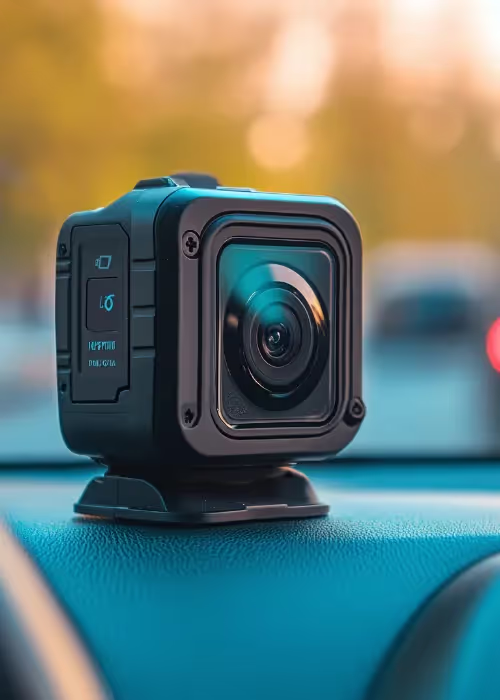
The safest universal approach is mounting the camera on the dashboard or directly behind the rearview mirror, which keeps it compliant in the large majority of states. For the full breakdown of rules by state, ExpertMarket's dash cam law guide is a useful reference before fitting out a fleet that operates across multiple states.
Commercial Vehicles Follow a Federal Placement Standard
Commercial trucks get a specific federal rule that sits alongside state law. Under FMCSA regulations, dash cams and similar safety technology can be mounted:
- No more than 8.5 inches below the upper edge of the area swept by the windshield wipers
- No more than 7 inches above the lower edge of that same area
- Completely outside the driver's sight lines to the road, signs, and signals.
This gives commercial fleets a consistent standard to build around, even when individual state rules differ for non-commercial vehicles.
Audio Recording Depends on One-Party or All-Party Consent
Video is the easy part. Audio is where fleets run into real legal risk.
Most states follow one-party consent: a conversation can legally be recorded as long as one participant, which can simply be the driver, knows about and agrees to the recording.
A smaller group of states require all-party consent, meaning everyone whose voice is picked up needs to know about and agree to the recording. Based on state-specific guidance, these include:
- California
- Delaware
- Florida
- Illinois
- Maryland
- Massachusetts
- Michigan
- Nebraska
- Nevada
- New Hampshire
- Oregon
- Pennsylvania
- South Dakota
- Washington
Connecticut has a split rule: all-party consent for electronic communications, one-party for in-person conversations in the vehicle.
Recording audio without the required consent isn't just a compliance issue. Federal wiretap law also applies, and intentionally intercepting an oral communication without proper consent can carry criminal penalties on top of any state-level consequences.
The simplest fix for most fleets is to keep the microphone off unless there's a clear operational reason to use it. If audio is needed, a visible sign inside the vehicle stating that recording is in progress is the standard way to establish consent in all-party states.
Some States Restrict Visible Dash Cam Screens Too
A handful of states go beyond placement and consent to regulate the screen itself. Illinois and Pennsylvania both restrict any video screen being visible to the driver while the vehicle is moving, aside from limited exceptions such as navigation.
New Hampshire runs the opposite way, actually requiring the dash cam's screen to be visible to the driver. It's worth checking this specifically if a fleet operates in either direction, since it's easy to assume the rule is the same everywhere.
Recording on Private Property Needs Permission
Dash cams filming a public road are generally fine everywhere. The moment footage is deliberately aimed at private property, such as a customer site or delivery location, permission from the property owner becomes important.
Incidentally capturing a driveway or yard while driving past on a public road isn't usually a problem. Positioning a camera to continuously monitor private property is a different matter and can trigger separate privacy or surveillance concerns.
Handling Footage After an Incident
How footage is preserved and handled after an incident matters as much as how it's recorded.
- Deleting or altering footage relevant to an investigation can amount to obstruction of justice, a federal offense
- In civil cases, failing to preserve footage, even unintentionally, can lead a court to assume the missing footage was unfavorable to the business
- Courts generally expect accurate timestamps, intact metadata, and a clear chain of custody before accepting footage as evidence
For fleets, this means automating backups, keeping a consistent retention policy, and training drivers not to touch footage after an incident beyond saving it securely.
What Happens If Police Ask for Dash Cam Footage
Police may ask for dash cam footage at the scene of an accident, but you're generally not required to hand it over without a warrant. Digital storage devices carry strong constitutional protection, a principle the Supreme Court confirmed in Riley v. California.
There are exceptions. Probable cause combined with a genuine risk that evidence will be destroyed can justify seizing the device, and a valid subpoena can compel footage to be produced in an active investigation.
Fleet drivers should know they can decline a request at a routine accident scene with no criminal investigation underway, while still cooperating with any properly issued warrant or subpoena.
Interstate Fleets Should Plan for the Strictest State
Consent laws apply based on where the vehicle physically is, not where the fleet is based. A driver who crosses from a one-party consent state into an all-party consent state becomes subject to the stricter rule the moment they cross the line, with no grace period.
For any fleet that regularly crosses state lines, the practical approach is to build policy around the strictest rule likely to apply anywhere on the route, rather than tracking which rule applies in which state in real time. In most cases, that means treating every vehicle as if all-party consent applies, or simply keeping the microphone off altogether.
Building Dash Cam Compliance Into Fleet Operations
Dash cam compliance works best as part of everyday fleet management, alongside vehicle checks, driver behavior monitoring, and incident reporting.
Connected dash cam systems that combine footage with secure storage, consistent retention settings, and controlled access make it easier to stay compliant across every state a fleet operates in, not just the one it's based in.
Get in touch for a free quote and see how the right dash cam setup can keep your fleet compliant and protected.
FAQs
Am I required to share dash cam footage with another driver's insurance company?
Generally no, you're not required to volunteer it. That said, if a dispute goes to litigation, both sides typically have to share relevant evidence during discovery, and withholding footage you know exists can work against you at that stage.
Can a police officer ask to see my dash cam footage during a routine traffic stop?
No, not as a matter of course. Officers generally can't ask to view your dash cam footage simply because they've pulled you over. They need evidence that a crime has occurred, or a warrant, before they can insist on seeing it.
Where can I legally mount a dash cam in a commercial truck?
Under FMCSA rules, commercial vehicle dash cams can sit no more than 8.5 inches below the upper edge of the wiper-swept area, no more than 7 inches above the lower edge, and must stay outside the driver's sight lines to the road and signage.
Can police take my dash cam footage without a warrant?
Generally no. Digital storage devices have strong constitutional protection, and police typically need a warrant or a valid subpoena to access footage, outside of limited emergency exceptions.
What happens if I delete dash cam footage after an accident?
It can create serious legal risk. Deleting footage relevant to an investigation can amount to obstruction of justice, and in civil cases, courts can assume deleted footage would have been unfavorable to the business.
About the author
Richard Blown is Chief Technology Officer at RAM, where he leads product innovation and technical strategy.
With over 25 years of experience in fleet telematics and connected vehicle technology, Richard has pioneered solutions that bridge the gap between theoretical safety improvements and practical business benefits.
His hands-on approach to product development ensures RAM's solutions solve real-world problems faced by fleet operators across the US.
Reduce costs, improve visibility, and keep your business running efficiently with RAM solutions.