Frost Jacking and the Law
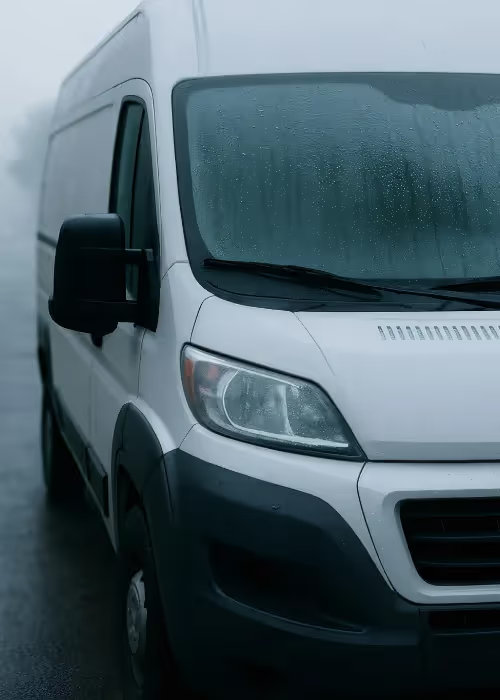
It's 7am, the van is white over and the first job is across town. Starting the engine, cranking the heater and nipping back inside for a coffee feels like the sensible option.
It's also one of the easiest ways to lose a vehicle this winter.
This guide explains what frost jacking is, what UK law says about leaving an engine running, how it affects your insurance, and what fleet managers can do to protect drivers and vehicles on cold mornings.
What frost jacking means
Frost jacking is when thieves steal a vehicle that's been left running and unattended while it defrosts. The RAC describes it as opportunist thieves taking an unlocked, idling car on a cold morning.
It doesn't take planning or special tools. A thief only needs a few seconds, an open door and a running engine. That's why it tends to spike during cold snaps, when more vehicles are left warming up on driveways and roadsides.
For businesses, the loss isn't just the van. It's the tools and stock inside, the jobs that can't be done that day and the time spent dealing with police and insurers. If tool theft is already a concern for your team, our guide to protecting tools in vehicles covers more ways to reduce that risk.
UK law on leaving your engine running
Leaving your engine running unattended on a public road is against the law. Rule 123 of the Highway Code says you must not leave a parked vehicle unattended with the engine running, and must not leave an engine running unnecessarily while stationary. It's backed by regulations 98 and 107 of the Road Vehicles (Construction and Use) Regulations 1986. As the RAC points out, these rules only apply to public roads, so it isn't an offence on private land, such as a driveway.
A private driveway doesn't make it a safe choice, though. A van idling on a driveway is just as easy to steal, and the insurance problem below still applies.
Engine idling fines
The standard fixed penalty for stationary idling is £20, and an officer will usually ask you to switch off before issuing it. The same RAC guidance points out that penalties vary between councils and between nations. For example:
- City of London - A £20 Fixed Penalty Notice rises to £40 if unpaid within 28 days, or an £80 Penalty Charge Notice rises to £160 if unpaid within 14 days.
- Wales - The Welsh Government has replaced the £20 fine with a new idling penalty range of £75 to £150 from 30 September 2026.
There are a few exceptions. Running the engine is allowed when you're stuck in traffic, when a mechanical fault needs investigating, or during certain roadside work.
Frost jacking and your insurance
If a vehicle is stolen this way, your insurer probably won't pay out. The Association of British Insurers warns that leaving keys in the ignition of an unattended vehicle could invalidate your cover. Many policies include a "keys in car" exclusion for exactly this reason.
The Financial Ombudsman Service has seen this happen. In one ombudsman case, a driver left his car running on his driveway to de-ice while he went back inside. The car was stolen, his insurer refused the claim, and the ombudsman agreed the insurer had acted fairly.
For a fleet, that could mean covering the full cost of a replacement vehicle, plus everything inside it, out of your own budget. It's worth checking your policy wording and sharing the key points with drivers before winter sets in. Our page on fleet van insurance explains how security measures can affect your cover.
Why this matters more for businesses
Vehicle theft is still a big problem in the UK. Almost 122,000 car thefts were reported in England and Wales between April 2024 and March 2025, and around three quarters of those cases ended without a suspect being identified.
When a business vehicle is taken, the knock-on effects add up quickly:
- Lost working time - A missing van can mean cancelled jobs, rearranged schedules and unhappy customers.
- Stolen equipment - Tools, stock and customer property often go with the vehicle.
- Fines land on the driver - Idling and visibility penalties are issued to the person in charge of the vehicle, which can cause friction within your team.
- Wasted fuel - Idling burns fuel without moving the vehicle anywhere. Idling for an hour can waste half a gallon of fuel or more, according to the Welsh Government, which also cites Royal College of Physicians estimates linking air pollution to around 30,000 UK deaths in 2025. You can read more in our guide to cutting excessive idling.
The law on clearing your windscreen
The other half of the winter morning problem is visibility. Rule 229 of the Highway Code says you must be able to see before you set off, which means clearing snow and ice from every window, not just a small patch in front of the driver.
Failing to clear your windscreen properly can lead to a fixed penalty notice under the CU20 code. CU20 covers using a vehicle with parts or accessories in a dangerous condition, and it carries 3 penalty points.
While you're clearing the glass, check that lights, mirrors and number plates are clear too.
How to de-ice your vehicle without breaking the law
The safest approach is simple. Stay with the vehicle, give yourself enough time and use the right kit. The RAC recommends allowing about 10 minutes to clear your windscreen with a scraper and de-icer.
Here's a quick routine drivers can follow:
- Start the engine and stay with it - Sit inside or work around the vehicle while it warms up. If you need to go back indoors, switch off and lock up.
- Use the heater properly - Point warm air at the windscreen and switch on the air conditioning to help remove moisture, with recirculation turned off.
- Spray and scrape - Apply de-icer, then clear every window, mirror, light and number plate with a proper scraper rather than a bank card.
- Leave the kettle in the kitchen - The RAC warns that boiling water can crack your windscreen through thermal shock.
- Prepare the night before - A windscreen cover, or parking under cover where possible, can save time in the morning.
For a fuller set of cold weather checks, our winter driving checklist for fleets covers tyres, lights, screenwash and emergency kits.
Building frost jacking into your winter fleet policy
Most frost jacking happens because someone is in a rush. A clear policy takes the guesswork out of busy mornings.
Consider including:
- A "never leave it running" rule - Make it clear that engines are switched off and vehicles locked whenever the driver steps away, even for a minute.
- Time for de-icing - Build extra time into early starts on frosty days, so drivers aren't tempted to cut corners.
- Key fob guidance - Keyless fobs should be kept on the driver, not left on the dashboard or in a door pocket.
- Kit in every vehicle - Make sure each van carries a scraper and de-icer.
- Walkaround checks - Add "all windows, lights and plates clear" to your daily walkaround checks during winter.
- A quick briefing - Remind drivers about the fines and the insurance risk at the start of the cold season. It takes five minutes and could save a vehicle.
How vehicle tracking helps on frosty mornings
Good habits are the first line of defence. Vehicle tracking gives you a second one.
With RAM, you can:
- See ignition events - Every engine start and stop is logged with a timestamp and GPS location, so you can spot vehicles being used outside working hours.
- Spot idling - Idling reports show where engines are running while vehicles sit parked, helping you tackle the habit and the fuel it wastes.
- Get alerts for unexpected movement - Geofences, time-based alerts and unauthorised movement notifications let you know if a vehicle moves when it shouldn't.
- Share a live location with police - If a vehicle is stolen, you can give police its exact location to help with recovery.
Find out more about how vehicle tracking protects against theft, or see how van tracking works for smaller fleets.
Before you head out this winter
Frost jacking is easy to prevent. Stay with your vehicle while it warms up, clear every window properly and never leave keys in an unattended van. For fleets, a short winter policy and the right tracking tools mean fewer fines, lower risk and vehicles that are still there when your drivers need them.
Book a demo to see how RAM can help protect your fleet this winter.
Frequently asked questions
Is it illegal to leave your car running to defrost it?
Yes, if it's parked on a public road and you walk away from it. Leaving a vehicle unattended with the engine running breaks Rule 123 of the Highway Code and can lead to a fixed penalty. It isn't an offence on a private driveway, but you still risk the vehicle being stolen and your insurance claim being refused.
Can I sit in my car with the engine running to keep warm?
Not if you're parked on a public road. Rule 123 of the Highway Code says you must not run an engine unnecessarily while stationary, and if you're likely to be stopped for more than a couple of minutes, you should switch off. The only exceptions it gives are sitting in traffic or diagnosing a fault.
Do I need to clear snow off my van roof before driving?
Yes. Along with clearing every window, light and number plate, Rule 229 tells drivers to remove any snow that could fall into the path of other road users. On a high van roof, a long-handled snow brush makes this much easier and safer.
Could my insurer still pay out if my vehicle is stolen while defrosting?
Possibly, but don't count on it. The Financial Ombudsman Service judges each case on its own facts. It says it might expect an insurer to pay if the driver was called away to an emergency, and it also checks whether the insurer clearly highlighted the exclusion when the policy was sold.
Do the idling rules apply to work vans and lorries?
Yes. Rule 123 covers any vehicle parked on a public road, so a van or HGV left running outside a customer's site is treated the same way as a car.
Can a vehicle tracker stop frost jacking?
Not on its own. A tracker won't stop an opportunist jumping into a running van, which is why a firm "never leave it running" rule matters most. Tracking helps straight afterwards, with an alert if the vehicle moves when it shouldn't and a live location you can pass to police.
About the author
Michael Hoyle is the Head of Account Management at RAM, where he leverages over 7 years of industry experience to drive customer success and operational excellence.
With a deep understanding of job management solutions and fleet tracking technology, Michael has established himself as a trusted leader in the telematics space.
His customer-centric approach and analytical mindset have helped countless businesses optimise operations, reduce costs, and improve efficiency.
Reduce costs, improve visibility, and keep your business running efficiently with RAM solutions.