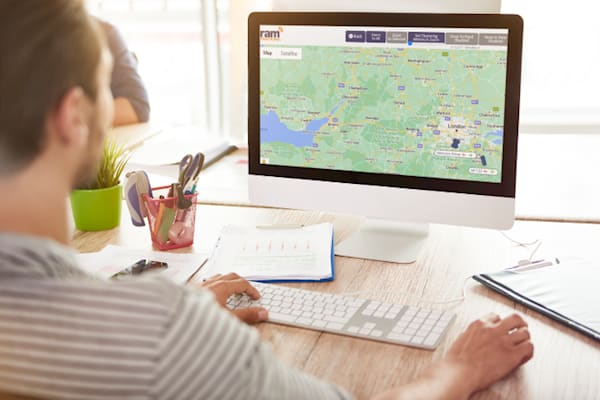
Having GPS fleet tracking alongside the important use of the telematics data that vehicle tracking provides you, allows you to gain access to crucial information about your fleet. This information can be used to improve your business operations.
By utilising a GPS fleet management system, businesses are able to understand everything, such as vehicle speed and location, using GPS technology. This isn’t where it ends, though, as a good system will apply reporting to collate data in a way that is easy to read.
Give your drivers a way to provide important information such as:
This is a term that refers to any fleet management software that takes telematics data alongside GPS technology.
GPS fleet management is comprised of three parts:
GPS (Global Positioning System)
A GPS takes advantage of satellites in space; a minimum of three satellites are used to ‘triangulate’ the current location of something that is giving off a signal, in this case, a vehicle tracker.
These satellites will pick up on the signal and provide you with a location of the tracker, showing you:
Vehicle Telematics
Vehicle telematics is a combination of the words telecommunications and informatics. Your vehicle tracker collects GPS data as well as a vast range of vehicle-specific information and transmits it to a centralised server to then be displayed to the end user. This data includes important info such as location, speed, idle time, rapid acceleration, harsh braking and much more.
Fleet Management Software
Fleet management software takes all of the information collected and helps your business to better manage its fleet through the use of this information. It’s a simple yet effective way of improving your fleet’s efficiency.
Not only can you supercharge your fleet’s performance, but additionally, you can:

When you take advantage of GPS tracking and fleet management, you will notice the various benefits that come with it. So, how can it help?
Optimise Your Fleet’s Maintenance
Vehicle maintenance is one of the largest expenses for most fleets, having to deal with unexpected breakdowns and various repairs due to wear and tear across any sized fleet becomes a real problem when not properly managed. Using our feature that makes drivers submit a daily vehicle check helps you to understand when a vehicle needs attention before it breakdown minimising it's time off the road.
When a driver fills out their Daily Vehicle Checks, you can see if there are any issues, which allows you to:
Discover how vehicle checks can protect your fleet through our handy guide.
GPS tracking for businesses refers to the use of fleet management software that combines telematics data and GPS technology to monitor and manage a fleet of vehicles. This technology provides real-time information about vehicle location, speed, and other important metrics to improve business operations.
GPS tracking helps businesses by providing accurate and real-time information about their fleet's activities. It allows for efficient fleet management, optimisation of maintenance schedules, improvement of driver safety, reduction of fuel consumption, and overall enhancement of business operations.
GPS tracking provides real-time information about the tracked vehicle's current speed, location, turns, harsh breaking, and harsh acceleration. This data is collected using GPS technology and transmitted through telematics to the fleet management software for analysis.
GPS tracking improves fleet safety by enabling businesses to monitor driver behaviour. This includes analysing aspects such as rapid acceleration, harsh breaking, speeding events, and distance driven. By identifying unsafe driving practices, businesses can implement training and reward safe driving behaviour.
GPS tracking reduces fuel consumption by tracking factors such as idle time and refuelling frequency. By identifying inefficient fuel usage patterns, businesses can provide targeted training to drivers to reduce unnecessary fuel wastage, leading to cost savings.
GPS tracking positively impacts a business's bottom line by optimising fleet maintenance, improving driver safety, reducing fuel consumption, and enhancing overall fleet efficiency. It leads to cost savings, increased productivity, and better resource allocation.
Do you have a question? Ask us anything